KSM Model Logo
KSMmodel.ai presents the official KSM Model™ AI Visibility Assessment
Created by Dr. Anthony Q. Bowen

AI Does Not Reward Noise. It Rewards Structure.

AI systems don't rank pages the way search engines do. They retrieve, parse, compare, cite, and synthesize structured knowledge. When the structure is weak, the entity gets diluted — or replaced.

No credit card required — results in under a minute

Based on the Knowledge Structuring Model™ Framework
§01 · The Problem
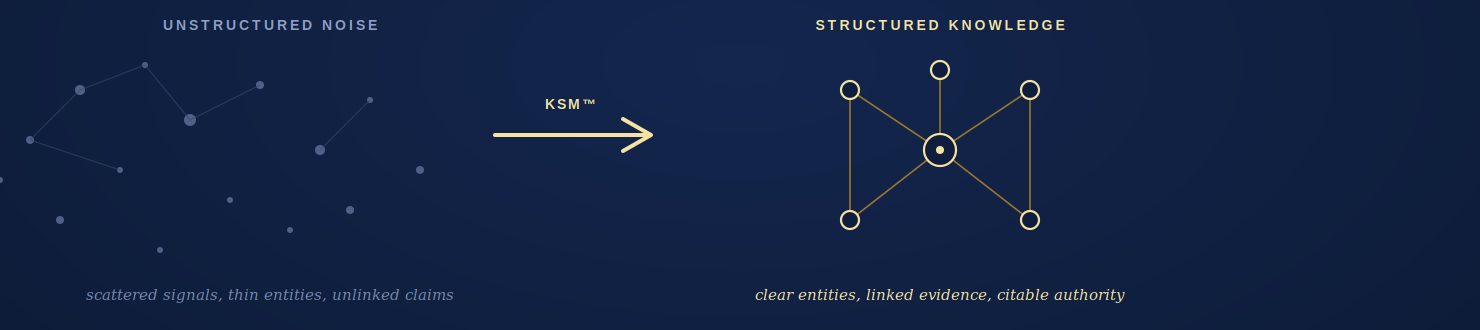
Unstructured noise — scattered signals, thin entities, unlinked claims — transformed by the KSM™ framework into structured knowledge with clear entities, linked evidence, and citable authority.
Brands are invisible
when AI can't parse them cleanly.
Experts are overlooked
when their entity signals are thin.
Ideas get diluted
when citations don't reinforce them.
SEO is not enough
for AI answer visibility.
§02 · The Framework

Three Pillars. One Signal of AI Visibility.

KSM Model™ evaluates AI visibility as a system of interdependent signals. Strong content isn't enough if the entity layer or citation layer is weak — and no pillar is scored in isolation from the other two (see §03 for how they combine).
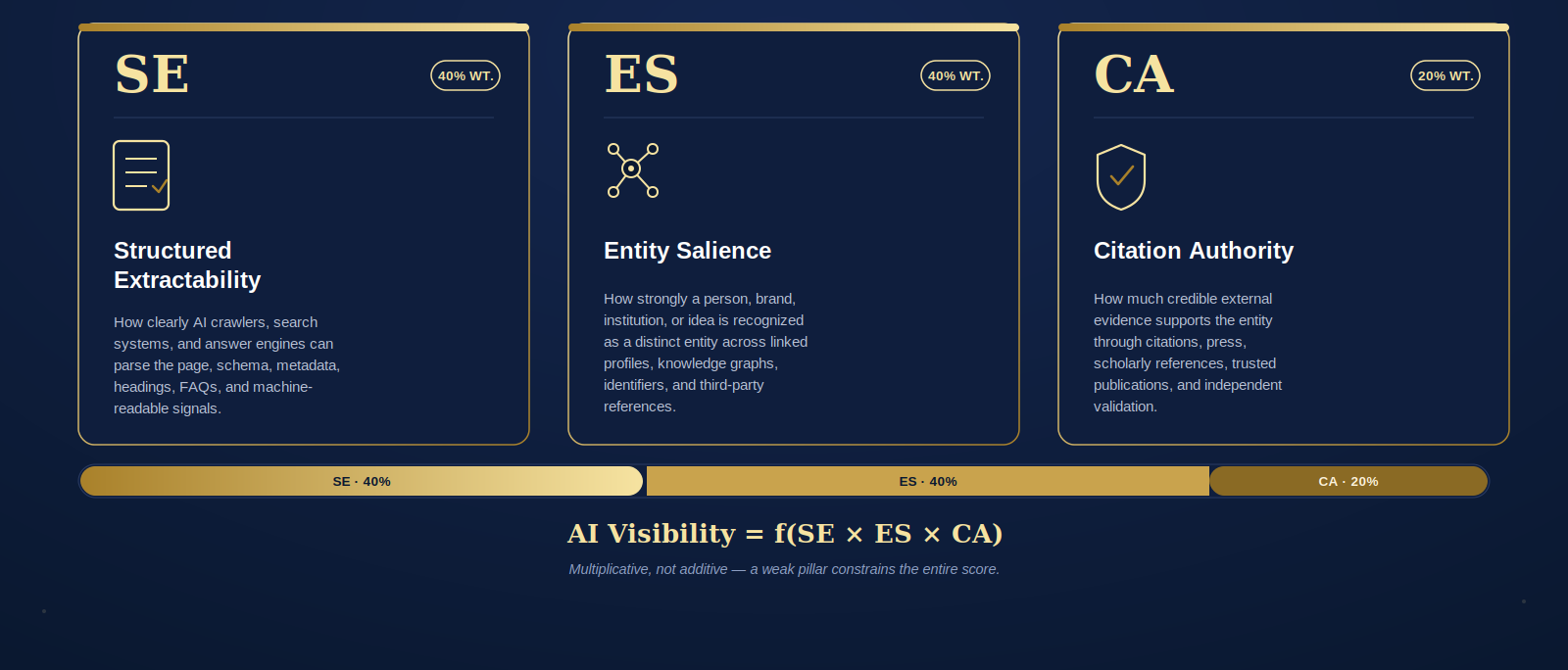
The three KSM™ pillars — Structured Extractability weighted 40%, Entity Salience weighted 40%, and Citation Authority weighted 20% — combining multiplicatively into AI Visibility = f(SE × ES × CA), where a weak pillar constrains the entire score.
SE

Structured Extractability

How clearly AI crawlers, search systems, and answer engines can parse the page — schema, metadata, headings, FAQs, and machine-readable signals.

ES

Entity Salience

How strongly a person, brand, institution, or idea is recognized as a distinct entity — across linked profiles, knowledge graphs, identifiers, and third-party references.

CA

Citation Authority

How much credible external evidence supports the entity — citations, press, scholarly references, trusted publications, and independent validation.

§03 · The Formula

KSM Model™ Composite Signal

AI Visibility = f(Structured Extractability × Entity Salience × Citation Authority)
Composite score, 0–100 — weighted SE 40 · ES 40 · CA 20.

The pillars combine multiplicatively, not by simple average: a site can perform well on content and still underperform in AI answers if the entity or citation layer is weak. If any single pillar falls critically low, the composite is capped — no amount of strength elsewhere can buy back a grade above a C. KSM Model™ makes that gap visible instead of averaging it away.

§04 · What KSM Model™ Measures

The Signal Layer Behind Every Score

Structured Signals
  • Schema and metadata
  • Heading hierarchy
  • FAQ and answer extractability
  • Machine-readable evidence blocks
Entity Signals
  • Knowledge graph presence
  • ORCID, Wikidata, Scholar
  • Institutional identifiers
  • Cross-web sameAs consistency
Citation Signals
  • Press and third-party citations
  • AI query recognition
  • Citation risk
  • Entity ambiguity and name collision
§05 · Use Cases

Built for People, Brands, and Institutions That Must Be Recognized

Academic Experts
Establish scholarly entity presence across Scholar, ORCID, and Wikidata.
Founders
Anchor personal-brand entity signals to a defensible knowledge surface.
Consultants
Turn thought leadership into citable, extractable, AI-visible authority.
Institutions
Map organizational entities to a durable knowledge-graph footprint.
AEO / GEO Strategy
Move beyond SEO into answer-engine and generative-engine visibility.
Citation Planning
Strengthen the third-party evidence base that AI systems rely on.
§06 · About the Model

An Open Standard for AI Visibility

The Knowledge Structuring Model was formalized by Dr. Anthony Q. Bowen and is maintained as an open framework for measuring entity discoverability, structured extractability, and citation authority in the age of generative retrieval.

About the StandardRead the Methodology
§07 · Frequently Asked

Common Questions About the KSM Model™.

What is the KSM Model™?

A framework formalized by Dr. Anthony Q. Bowen for measuring how clearly a person, brand, institution, or idea can be discovered, extracted, cited, and trusted by AI systems such as ChatGPT, Claude, Gemini, and Perplexity.

How is the KSM Model™ different from traditional SEO?

Traditional SEO optimizes for ranked links on a results page. KSM Model™ measures whether an entity is structured well enough to be parsed, recognized, and cited inside an AI-generated answer — where there's no ranked list, and citation authority decides who gets named.

Is the free scan really free?

Yes — no credit card required. The free scan gives you your overall AI Visibility grade and a preview of where each pillar stands. The full breakdown — complete pillar diagnostics, your AI Snapshot across ChatGPT, Perplexity, and Gemini, and your 90-Day Roadmap — unlocks with a 7-day free trial.

What happens after my 7-day trial?

You keep the full report you generated during the trial. If you don't continue, your account moves to the free tier — re-scans and roadmap tracking pause, but nothing you've already unlocked disappears.

Do I need to give you access to anything?

No. The scan reads only what's already public on your site and public AI outputs — no login, no integration, no special access required.

Who created the KSM Model™?

Dr. Anthony Q. Bowen, DBA. Documented in peer-reviewable research including SSRN working paper 6721140, and maintained as an open framework for AI visibility measurement.

See Your AI Visibility Score

Enter your domain. Get your grade in under a minute — no card required.

Run Your Free Scan
KSM™ · Dr. Anthony Q. Bowen, DBA · ksmmodel.ai · SSRN 6721140