
The KSM Model™ Score — Methodology
The KSM Model™ Score is a 100-point composite built from three pillars, weighted 40 / 40 / 20:
| Pillar | Weight | Measures |
|---|---|---|
| E — Structured Extractability | 40 pts | Can AI understand you? |
| S — Entity Salience | 40 pts | Can AI recognize you? |
| C — Citation Authority | 20 pts | Can AI trust you? |
Extractability and Salience are weighted evenly and heavier than Citation Authority, because a source can't be trusted or cited until it's first machine-readable and correctly identified. Citation Authority carries less raw weight but is the hardest to earn — third-party validation can't be self-published.
SEO vs. KSM™, at a Glance
Traditional SEO and KSM™ aren't competing for the same job. SEO gets a page found; KSM™ gets an entity understood, included, and cited. The table below maps that shift dimension by dimension — from core unit of value, to how content is discovered, to what actually counts as a success metric.
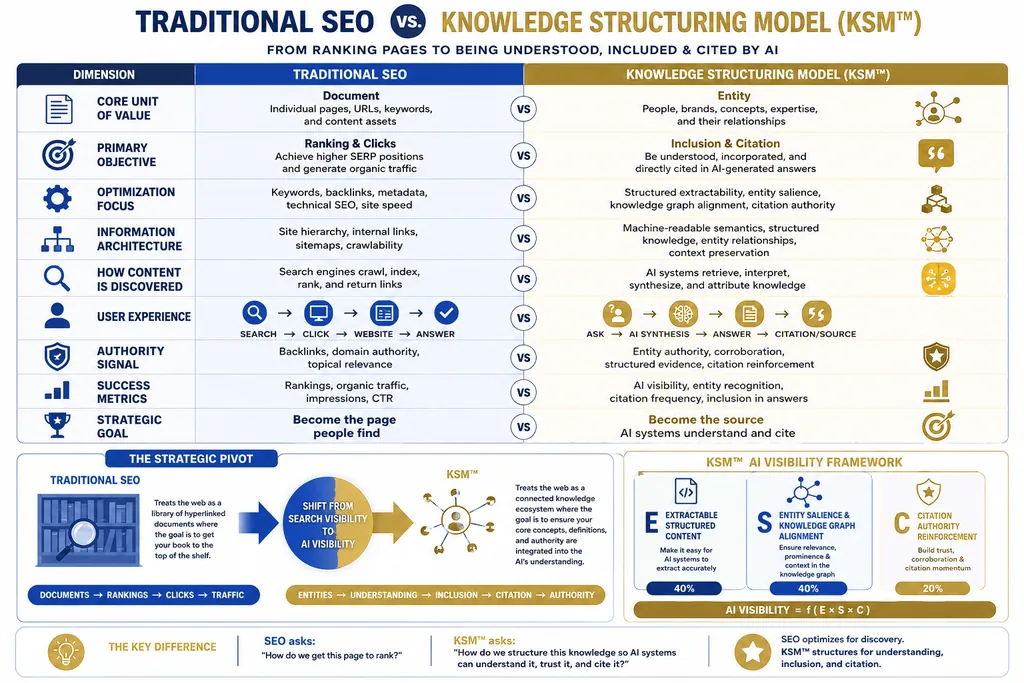
The short version: SEO asks "How do we get this page to rank?" KSM™ asks "How do we structure this knowledge so AI systems can understand it, trust it, and cite it?"
Why 40/40/20, and why it isn't just addition
The displayed score is a sum of the three sub-scores (e.g. 22 + 14 + 5 = 41/100), but the underlying model is multiplicative, not additive: AI Visibility = f(E × S × C).
That distinction matters. In a multiplicative system, a near-zero pillar caps the entire composite regardless of how strong the other two are — you can't average your way to visibility with two strong pillars and one collapsed one. The 100-point sum is a readable proxy for people; the multiplicative logic is what actually explains why a 41 behaves more like a "weak" score than a simple average would suggest, and why fixing the lowest pillar is always the highest-leverage move.
Pillar 1 — Structured Extractability (40 pts)
Whether machines — search crawlers, answer engines, non-rendering AI bots (GPTBot, PerplexityBot, Applebot) — can parse and lift your content cleanly.
| Sub-criterion | Points | What's checked |
|---|---|---|
| Schema.org / JSON-LD validity | 10 | Organization, Person, FAQPage schema present, valid, and error-free; nested @id linking (e.g. founder → ORCID) |
| Crawlability & indexation | 8 | robots.txt validity, sitemap status, meta-robots directives, confirmed indexation in Search Console / Bing Webmaster |
| On-page technical hygiene | 12 | H1 present, title tag length (~60 char), meta description length (~155 char, non-duplicated across meta/OG/Twitter), lang tag, image alt text |
| AEO-ready content structure | 10 | Dense FAQ blocks, clear headers, Q&A-formatted content that matches its own schema markup |
Common score-killer: structured data that's real but injected via JavaScript (e.g. Google Tag Manager) — invisible to crawlers that don't render JS. Valid schema that non-rendering bots can't see effectively scores as if it doesn't exist.
Pillar 2 — Entity Salience (40 pts)
Whether the entity itself — a person, org, or brand — is consistently and unambiguously represented across the knowledge graphs AI systems actually draw from.
| Sub-criterion | Points | What's checked |
|---|---|---|
| Knowledge graph presence | 14 | Live Wikidata node, Wikipedia article — the two signals AI knowledge-graph retrieval weights most heavily |
| Identifier consistency | 10 | ORCID, DOI, Scholar ID, sameAs linking between on-site schema and external profiles |
| Cross-platform presence | 8 | Institutional bios, LinkedIn, ResearchGate, Academia.edu — third-party-hosted anchors, not just self-published ones |
| Disambiguation | 8 | Whether the name/brand is unique enough in the corpus, or collides with unrelated prior use of the same term/acronym |
Common score-killer: no Wikidata node. It's the single highest-leverage line item in this pillar — its absence alone can hold Entity Salience under 50% even with strong identifier coverage everywhere else.
Pillar 3 — Citation Authority (20 pts)
Whether independent, third-party sources actually select and reference you — the signal that can't be self-published into existence.
| Sub-criterion | Points | What's checked |
|---|---|---|
| Peer-reviewed / indexed citation | 10 | Scopus/Web of Science-indexed citation of the underlying work — not just distribution on a preprint network |
| Independent third-party application/citation | 6 | Unaffiliated parties applying, referencing, or building on the work — and critically, whether that reference is itself indexed/discoverable |
| Press / industry citation | 4 | Media, competing vendors, or industry press referencing the entity or framework |
Common score-killer: real third-party validation existing but not yet linked from the source's own site or indexed anywhere crawlable. Unlinked proof contributes zero signal — evidence has to be discoverable to count.
Worked example — Dr. Anthony Q. Bowen / KSM Model™, July 2026 assessment
| Pillar | Score | Read |
|---|---|---|
| Structured Extractability | 22 / 40 | Strong schema and FAQ structure, undercut by five unresolved technical defects (missing H1, oversized meta, missing lang tag, unalt'd images, JS-only schema injection) |
| Entity Salience | 14 / 40 | Solid identifier trail (ORCID, Scholar, Zenodo) but no live Wikidata node, no Wikipedia, and a name-collision risk with unrelated prior "KSM" usage |
| Citation Authority | 5 / 20 | One genuine independent application exists but isn't yet linked or indexed; no peer-reviewed citation yet |
| Composite | 41 / 100 | Stage 2 — Structured Presence |
The takeaway the multiplicative model is built to surface: Structured Extractability is the strongest pillar here, but it can't lift the composite out of "weak" territory on its own — the Entity Salience and Citation Authority gaps are what's actually suppressing AI visibility, and they're where the next 60 days of work should go.
Read the full story behind this assessment: 90 Days of KSM™ →